
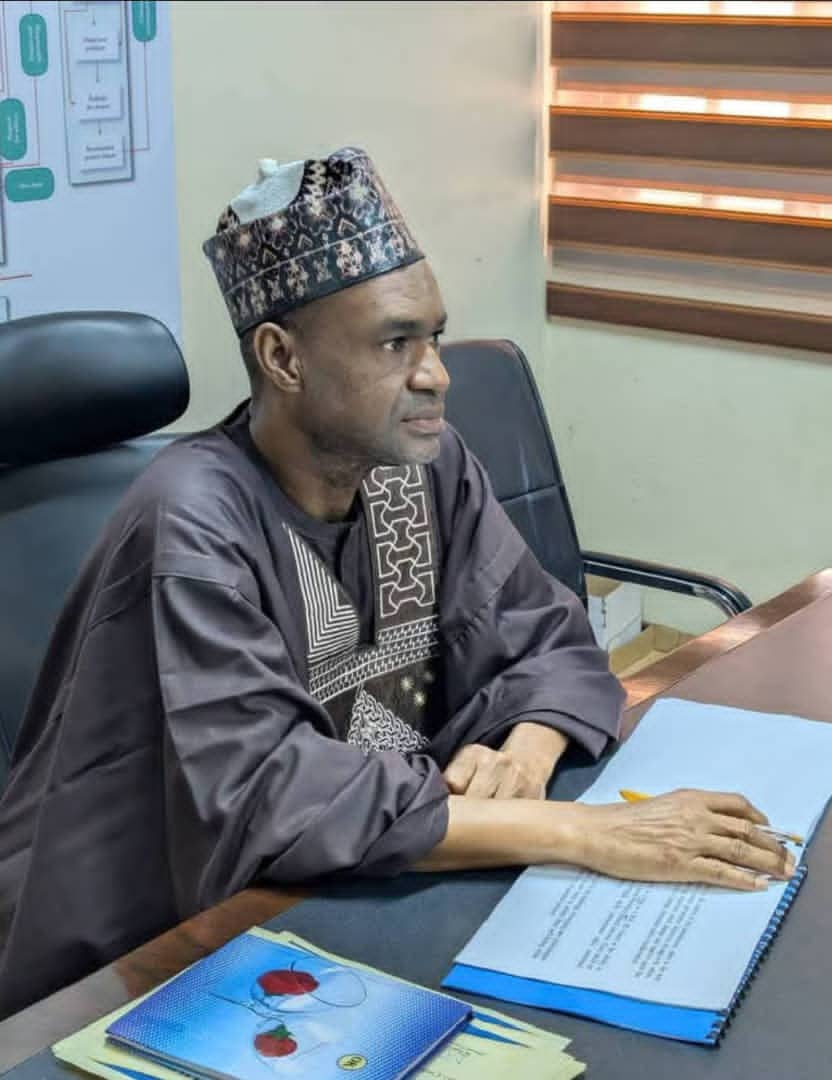
The appointment of Professor Ibrahim Danjuma as Rector of Adamawa State Polytechnic, Yola, has attracted controversial report by Sahara Reporters dated October 25, 2026, which questioned whether he possesses the required science and technology background and experience for the position.
The report cited Section 21(1) of the institution’s establishing edict, which requires a rector to have a sound educational background and experience in a field of science and technology. It also referenced Section 46, which reportedly stipulates at least 20 years of working experience, including six years within the polytechnic system.
However, Professor Danjuma’s academic qualifications, professional credentials and career history provide additional information about his background in technology and polytechnic education.
Danjuma began his career in 1992 as an Assistant Lecturer at Adamawa State Polytechnic, Yola, before moving to Federal Polytechnic, Mubi, where he served until December 6, 2005.
He subsequently returned to the polytechnic system, serving as a Visiting Principal Lecturer from 2014 to 2017 and Visiting Chief Lecturer at Federal Polytechnic, Mubi, from 2017 to 2020.
His career records indicate that he accumulated approximately 20 years of polytechnic experience across the periods 1992–2005 and 2014–2021.
He also served as Head of Department of Management at Federal Polytechnic, Mubi, a member of its Academic Board for seven years, and a member of the Governing Council of Adamawa State Polytechnic, Yola, for four years.
Danjuma holds a PhD in Management Sciences, with specialisation in Technopreneurship and Innovations, alongside extensive experience in academic administration, research, consultancy and institutional governance.
His technology-related credentials include certificates in Computer Applications, Technology Design and Programming, Data Science and Machine Learning, Computer Science, and Information Systems Security. He also holds a Diploma in Information Technology Support.
In addition, he recently obtained Full Membership of the Academia in Information Technology Profession (AITP), an interest group of the Nigeria Computer Society. The certificate, dated October 23, 2026, confirms his admission as a full member of the profession.
His professional affiliations also include membership of the Institute of Electrical and Electronics Engineers (IEEE), alongside other professional bodies in management, entrepreneurship and related fields.
These credentials demonstrate his engagement with computing, information technology, innovation and technology-related professional development.
Beyond his polytechnic experience, Danjuma served as Head of Department, Deputy Dean and Dean at Modibbo Adama University, Yola, and was a member of its Senate for 13 years.
His experience across both polytechnic and university systems provides exposure to academic administration, institutional governance, quality assurance, staff development and research.
Adamawa State Polytechnic also operates programmes across science and technology, management, environmental studies, arts, education, social sciences, entrepreneurship and other disciplines, requiring leadership capable of coordinating diverse academic areas.
Besides, according to the National Board for Technical Education (NBTE) guidelines for appointing Polytechnic Rectors require candidates to possess a PhD in a relevant discipline, substantial teaching and administrative experience, and a strong understanding of technical education.
The guidelines also emphasise professional qualifications, research contributions, leadership capacity and proficiency in Information and Communication Technology (ICT). These requirements underscore the importance of academic competence, institutional experience and technological knowledge in leading a modern polytechnic.
Prof. Ibrahim Danjuma’s professional background reflects several of these key requirements. As Rector, Danjuma has identified digital transformation, practical technical education, research, innovation, entrepreneurship, staff development and institutional partnerships among his priorities.
His academic qualifications, technology-related training and career history provide relevant context to the debate over his suitability for the position. A definitive assessment of statutory eligibility, however, should be based on the full provisions of the Polytechnic’s establishing edict and verified appointment records.
The focus now shifts to how his experience and training will translate into improved academic standards, technical skills development and institutional growth at Adamawa State Polytechnic.
By Muhammad B. Muhammad


